Hand bookbinding does not require a fully equipped studio. The three structures described below — Coptic, long-stitch, and Japanese stab-stitch — can each be completed at a kitchen table using tools sold at most Canadian art-supply shops. The choice between them comes down to how the book will be used: Coptic bindings open flat and suit sketchbooks; long-stitch bindings work well for journals with heavy paper; stab-stitch is the fastest option for single-signature folios and printmaking portfolios.
Materials and Tools
Before cutting any paper, assemble the following. Substitutions are noted where acceptable.
Paper
Text-weight papers between 60 gsm and 100 gsm fold cleanly without cracking. Heavier papers — watercolour stock, printmaking sheets — require scoring along the fold line with a bone folder before folding. Avoid papers labelled "acidic" or without a pH rating if the book is intended for archival storage; pH-neutral papers are stocked by most Canadian art retailers and by suppliers such as DeSerres.
Thread
Linen thread in 18/3 or 25/3 weight is standard for most hand bindings. Unwaxed linen thread should be pulled across beeswax before sewing to reduce friction and prevent tangling. In Canada, bookbinding thread is available through Chapters-Indigo craft sections and online through Hollanders (ships to Canada).
Adhesive
Polyvinyl acetate (PVA) adhesive — sold as bookbinding glue or white craft glue — is the standard choice for spine gluing and end-paper attachment. Wheat starch paste is preferred when working with historic papers because it remains reversible when re-humidified.
Other tools
- Bone folder — for scoring folds and burnishing
- Awl or bookbinding needle with a sharp point
- Metal ruler and cutting mat
- Binder clips or book press (two boards and a G-clamp work as well)
- Bookbinding needles: blunt curved needles for Coptic; straight blunt needles for long-stitch
Preparing Signatures
A signature is a small stack of folded sheets sewn together as a unit. Most hand bindings use signatures of four to six sheets (eight to twelve pages). The steps below apply to all three binding structures.
- Cut all text sheets to a consistent size. A guillotine trimmer produces cleaner edges than a craft knife and ruler, though both work.
- Nest the sheets and fold them together using a bone folder. Apply even pressure across the full length of the fold.
- Mark the sewing stations on the spine fold with a pencil. A consistent spacing of 20–25 mm between stations produces a neat, even stitch pattern.
- Pierce each station with the awl. Work on a padded surface — a folded piece of felt or a cork mat — to avoid blunting the awl point.
- Repeat for all signatures. Nest them in order and check that the sewing stations align when the signatures are stacked.
Grain direction: Paper expands and contracts along the short grain when humidity changes. Binding paper against the grain causes warping. Canadian suppliers typically note grain direction on packaging; if it is not marked, run a damp finger along each edge — the edge that curls is parallel to the grain.
Coptic Stitch Binding
The Coptic stitch originated in early Christian Egypt and produces a binding that opens completely flat at any page — a practical advantage for notebooks and reference books. The spine remains exposed, showing the thread pattern.
Structure
Signatures are linked directly to each other at the spine. There is no spine lining and no cover boards attached through the text block — the covers are sewn in as part of the stitch sequence. This makes the structure unusually flexible.
Sewing sequence
- Thread the needle with a length of waxed linen thread approximately four times the height of the book.
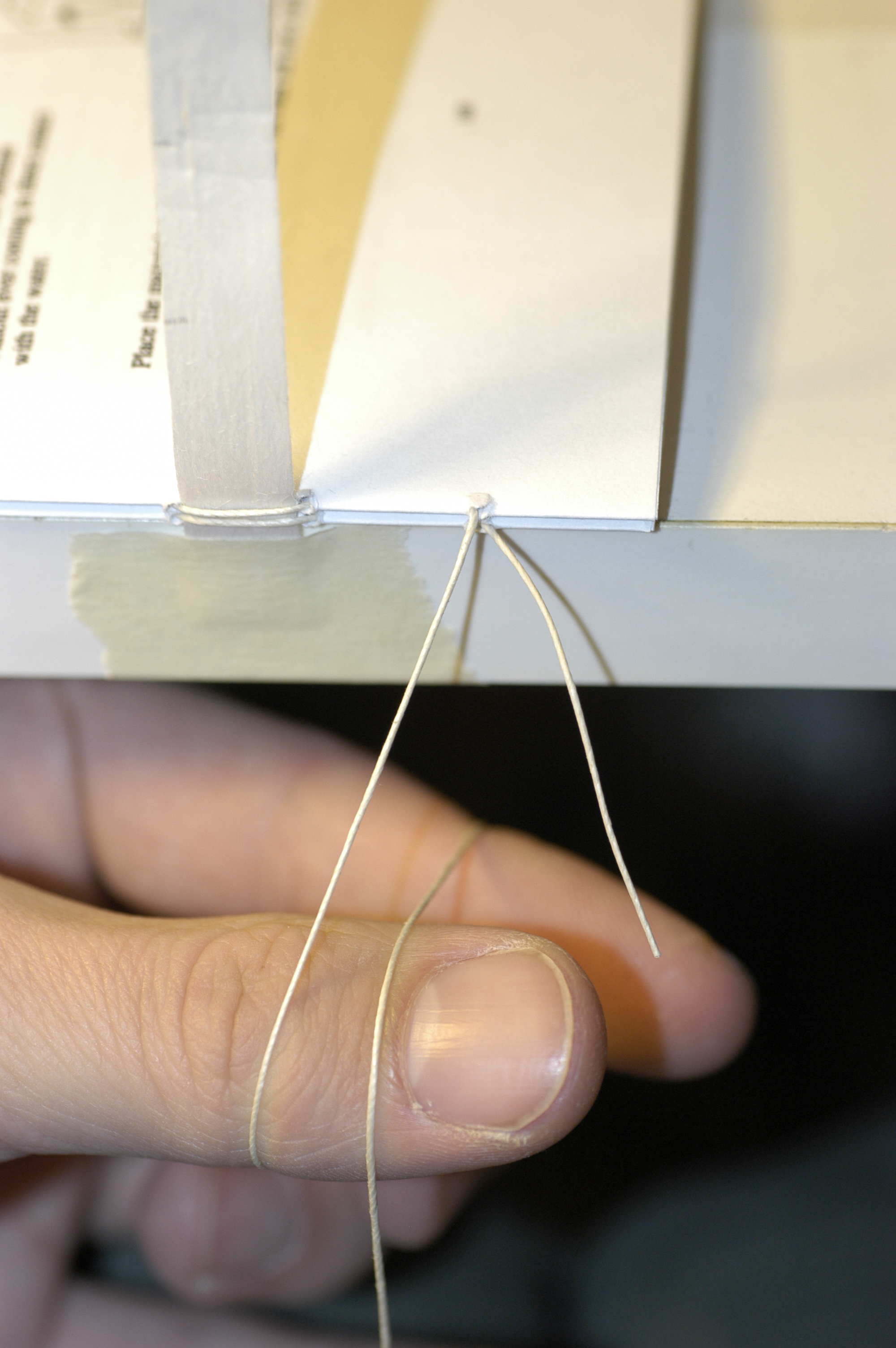
- Sew through the first station of the first signature from the inside out, leaving a 5 cm tail.
- Attach the cover board at the same station by passing through a pre-pierced hole in the board, looping back, and continuing to the next station.
- Add each subsequent signature by linking the new signature's stations to the previous signature using a kettle stitch — a small loop that locks the two signatures together before continuing through the new signature.
- Finish with two half-hitches at the final station and trim the thread to 1 cm.
Long-Stitch Binding
Long-stitch bindings are sewn through a limp or hard cover rather than linked signature-to-signature. The thread travels along the outside of the spine between sewing stations, creating a visible pattern that can be decorative.
This structure tolerates heavier paper better than Coptic because the cover absorbs more of the outward stress placed on the signatures. It is a good choice for watercolour journals where paper weight exceeds 200 gsm.
Cover preparation
For a limp cover, cut a piece of book cloth or heavy paper to wrap around the spine and overlap each cover board by at least 15 mm. Pierce the sewing stations through the spine section before assembling. The stations must align precisely with those in the text signatures.
Japanese Stab-Stitch Binding
Stab-stitch bindings are sewn through the full thickness of the text block, from front cover to back cover. They do not open flat, but the structure is simple and quick to execute — well-suited to portfolios, pamphlets, and short editions.
Common patterns
Four-hole stab, tortoiseshell, and hemp-leaf are the patterns most commonly found in North American craft literature. Each uses the same four pierced stations but routes the thread differently across the front cover. The thread path on the front cover is the only visual distinction between patterns once the book is closed.
Piercing the block
Clamp all sheets firmly between boards before piercing. A hand drill with a 1.5 mm bit produces cleaner holes than an awl through thick stacks — particularly important when working with more than 40 sheets.
Finishing and Storage
After sewing, place the completed book under boards with a moderate weight for at least two hours. This flattens any slight warping introduced during sewing. If PVA was used on the spine, allow 24 hours of drying time before trimming the fore-edge.
Store hand-bound books upright, supported on either side to prevent leaning. Avoid storing in direct sunlight or near heat sources. In Canadian winters, when indoor heating reduces relative humidity, a small humidifier near book storage helps reduce the risk of spine cracking.